
Evidence from six consecutive days of SCR 5-minute monitoring under high THI conditions, 17–22 July 2026
Heat stress remains one of the greatest challenges facing high-producing dairy cows. Most cooling strategies rely on intermittent relief—cows leave the pen several times each day for dedicated cooling sessions before returning to the bedding pack.
These systems cool cows effectively while they are in the cooling yard. The more important question is what happens after they return to the pen.
A commercial field trial comparing continuous in-pen cooling (Core Cool Systems – CCS) with conventional intermittent cooling provides a clear answer.
Groups 2 and 3 received cooling before each milking plus two additional cooling-yard sessions every day (five cooling events in total). Group 5 received the same cooling before milking but remained in the pen for the rest of the day under continuous targeted cooling over the bedding area and feed bunk.
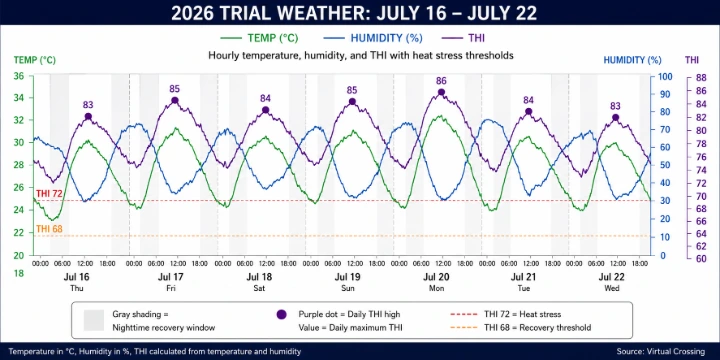
Environmental Conditions
The six-day monitoring period occurred during
a period of sustained summer heat stress. Daily Temperature-Humidity Index
(THI) reached 80–83 on multiple days, with prolonged afternoon periods well
above accepted heat stress thresholds. Overnight THI remained elevated,
limiting the cows' natural ability to dissipate accumulated heat. All three groups
experienced essentially the same environmental conditions.
Measuring the Herd's Physiological Response
Heat stress was evaluated using SCR Heavy Breathing (HB), a herd-level indicator representing the percentage of cows within the group identified as exhibiting heavy breathing during each five-minute measurement interval.
The Proportion of Cows Exhibiting Heavy Breathing Increased Soon After Returning to the Pen
Across all six days, Groups 2 and 3 showed a remarkably consistent pattern.
- HB declined while cows were in the cooling yard.
- Once cows returned to the bedding pack, the proportion of cows exhibiting heavy breathing began increasing again within 30–60 minutes.
- As afternoon heat load increased, progressively more cows within the herd exhibited heavy breathing until the next scheduled cooling event.
This produced a characteristic "saw-tooth" HB profile: effective short-term relief followed by a relatively rapid rebuilding of heat load between cooling sessions.

(Heavy Breathing is Red on the SCR graphs, Purple is Rumination and Green is Eating)

Continuous Cooling Changed the Pattern
Group 5 displayed a fundamentally different physiological response under the same environmental conditions.
- No comparable herd-wide HB spikes were observed.
- Peak HB values were consistently lower than those observed in Groups 2 and 3.
- A markedly more stable proportion of cows exhibited heavy breathing throughout the day.
Rather than repeatedly cycling between periods of relief and increasing heat load, continuous in-pen cooling maintained a more consistent physiological response throughout the day.
Dairy producers have long recognized that cows thrive on consistency. Consistent feeding, milking routines and daily management all support cow comfort and performance. These results suggest the same principle applies to heat stress. Maintaining a more consistent physiological response may be more effective than repeatedly allowing heat load to accumulate before removing it again.
(% of the group - heavy breathing is red on the SCR graphs; purple is rumination, and green is eating)

Why This Matters
Every additional cooling-yard session requires cows to leave the pen, walk, stand, cool, and then return before resuming their normal daily activities.
Groups 2 and 3 required two additional cooling-yard trips every day beyond normal pre-milking cooling. Group 5 eliminated those additional trips while maintaining a more stable HB profile under the same environmental conditions.
Returning approximately 90 minutes to the cows' daily time budget creates greater opportunity for normal behaviors such as resting, eating, and ruminating within the home pen while avoiding repeated cycles of heat accumulation between cooling events.
Conclusion
Six consecutive days of five-minute SCR HB monitoring demonstrated that intermittent cooling-yard sessions provided effective short-term relief. However, once cows returned to the bedding pack, the proportion of cows exhibiting heavy breathing consistently increased again within 30–60 minutes as heat load rebuilt between cooling events.
Continuous in-pen cooling produced a different physiological response. Rather than repeated herd-wide fluctuations in HB, Group 5 maintained lower peak HB values and a more stable proportion of cows exhibiting heavy breathing throughout the day while eliminating two additional daily cooling-yard sessions.
For high-producing herds exposed to prolonged summer heat, these results suggest that continuously limiting heat accumulation may be more effective than repeatedly removing heat after it has already developed.
Key Takeaway
The objective of heat stress management is not simply to cool cows during scheduled sessions.
It is to help prevent excessive heat load from developing in the first place.
Continue the Conversation
This article is one part of an ongoing commercial heat stress trial. As additional data become available, we'll continue sharing what we're learning.
If you'd like to discuss these results—or explore what continuous in-pen cooling could mean for your herd—we'd welcome the conversation.
WhatsApp: +1-330-717-8852
Email: info@corecoolsystems.com
RETURN TO THE CORE COOL SYSTEMS WEBSITE