
Farmers in hot regions know the struggle: high THI days with poor nighttime recovery take a toll on cows. Many systems move air or apply water, but what happens when you combine high-speed focused air, automated evaporative cooling, and smart controls?
An ongoing commercial trial in the Middle East gave us an unexpected answer.
Why Core Cool Systems Combines High-Speed Air + Evaporative Cooling + Automation.
High-speed air moves heat away from the cow. Evaporative cooling boosts her ability to lose heat through evaporation. Automation adjusts delivery in real time as conditions change. Together, they target core body temperature, not just the barn air, so cows stay comfortable where they eat, rest, and ruminate all day.
Other approaches such as fans, soakers, misters, or cooling yards can provide meaningful heat stress relief. Core Cool Systems was designed to combine high-speed air, evaporative cooling, and automation into a single system that continuously adapts to changing conditions throughout the day.
The Real-World Trial
In an ongoing Middle-Eastern dairy trial, three groups of lactating cows are being monitored using SCR technology to track heavy breathing, rumination, eating behavior, and milk production under real summer conditions.
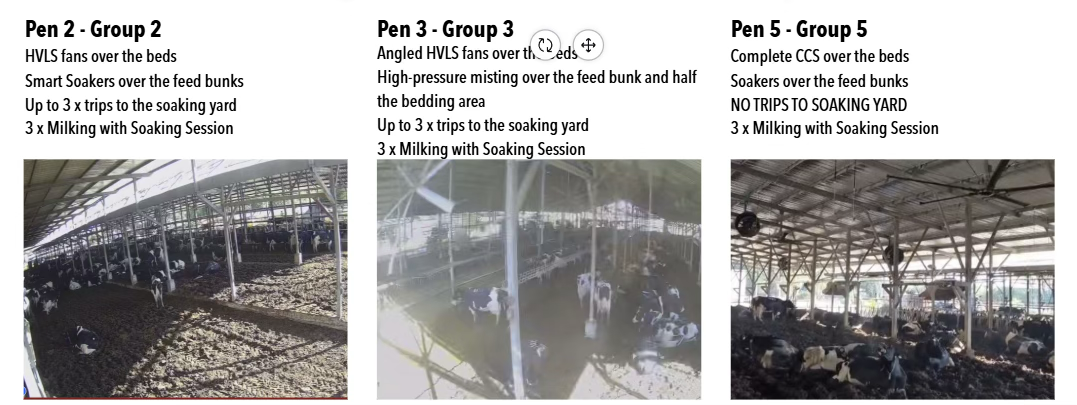
Group 2 - HVLS fans combined with sensor-activated bunk soakers and scheduled cooling-yard sessions.
Group 3 - 45-degree angled HVLS fans combined with a misting system and cooling-yard sessions.
Group 5 - is cooled using a complete Core Cool Systems installation that combines high-speed air, automated evaporative cooling, and THI-based automation.
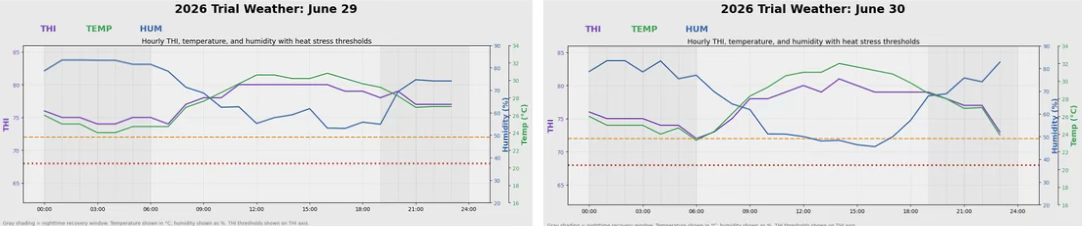
Weather conditions were nearly identical on June 29 and June 30, 2026, with THI peaking at approximately 80 to 81 during the afternoon and limited nighttime recovery on both days. These conditions created a useful opportunity to compare cow responses under similar environmental stress.
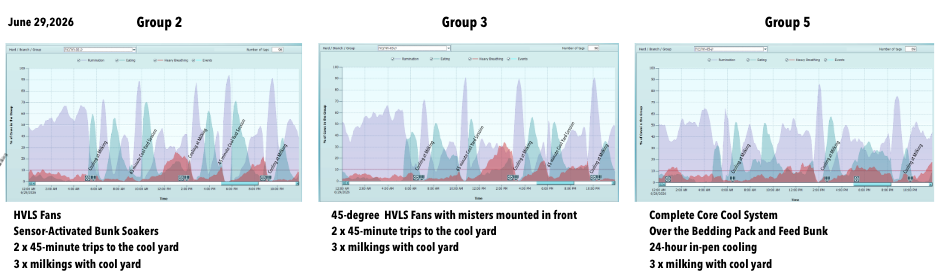
June 29: Full System Performance
As heat load increased throughout the day, all groups experienced increases in heavy breathing, which is expected during periods of elevated heat stress.
The SCR data showed that Group 5 maintained lower levels of heavy breathing throughout much of the afternoon heat period while rumination remained similar across all groups. The data suggested that cows cooled by the Core Cool Systems installation experienced less respiratory stress while maintaining normal behavioral activity.
June 30: The Unexpected Glitch
The following day brought nearly identical weather conditions.
The same cows remained in the same groups. Management practices remained unchanged. Heat load developed in a pattern very similar to the previous day.
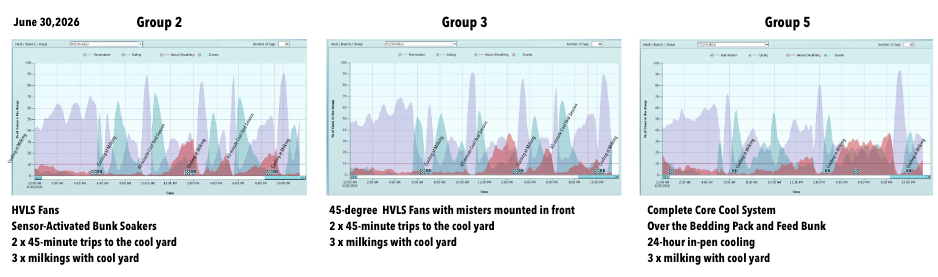
However, during the afternoon heat period, the controllers serving the Core Cool Systems group were accidentally shut off. The Core Cool units have a built-in fail-safe that automatically runs the fans at full speed to help protect the cows, but water delivery stopped. As a result, the cows continued receiving high-speed air, but evaporative cooling was no longer being applied.
The result was immediate and visible in the SCR data. Heavy breathing in Group 5 rose sharply and remained elevated longer during the hottest hours of the day compared to the previous afternoon. Groups 2 and 3 continued operating under their normal cooling programs and displayed patterns generally consistent with those observed on June 29.
The data showed a clear jump in respiratory stress precisely when evaporative cooling was removed.
While this was not a planned experiment, it created an unusual opportunity to observe the contribution of evaporative cooling under nearly identical weather conditions. Few field observations provide such a direct before-and-after comparison during an active heat stress event.
The Cows Told the Story
Nothing else changed.
The cows did not change.
The weather did not change.
Management did not change.
The primary difference was the loss of evaporative cooling within the Core Cool Systems group.
This was not a planned experiment, but it created a valuable field observation. By removing one component of the cooling strategy, the SCR data revealed how important that component is to maintain cow comfort during the afternoon heat load.
High-speed air continued to operate, but the response observed in the cows was different from the day before.
Why This Matters for Farmers in Hot Regions
If you've ever thought, "My farm is too hot or too humid for effective evaporative cooling," this trial challenges that assumption. On the day the evaporative cooling system stopped operating, temperatures reached 31°C, relative humidity reached 83%, and THI climbed to 81. Under those conditions, removing evaporative cooling corresponded with a measurable increase in heavy breathing.
One of the most common misconceptions in dairy cooling is that evaporative cooling loses its value in hot, humid environments. While humidity does influence evaporation rates, the June 29 observations demonstrated that combining evaporative cooling with high-speed air can still provide meaningful benefits under challenging conditions.
When the evaporative cooling component was unintentionally removed on June 30, respiratory stress increased despite similar weather conditions, suggesting that water application remained an important contributor to overall cooling performance.
The lesson from this event is not that airflow is unimportant. The lesson is that airflow and evaporative cooling perform different functions and work best together. Core Cool Systems was designed around that principle.
In hot climates where heat stress accumulates quickly and nighttime recovery is limited, the combination of high-speed air, evaporative cooling, and automation can help maintain cow comfort throughout the day.
Farmers using Core Cool report better heat stress management, protected milk production, and improved reproductive performance during challenging summer conditions. Results vary by farm, climate, management practices, and existing cooling infrastructure, but the objective remains the same: helping cows remain comfortable and cool where they spend most of their day.
Ready to Give Your Cows the Edge?
Don't settle for partial solutions that leave cows stressed when it matters most.
Contact us today for a free barn assessment, review the Middle East trial data with our team, or learn how a Core Cool Systems installation could fit your operation.
Core Cool Systems – Cooling the cow, not just the barn.